This pipeline computes the correlation between cancer subtypes identified by different molecular patterns and selected clinical features.
Testing the association between subtypes identified by 8 different clustering approaches and 10 clinical features across 26 patients, no significant finding detected with P value < 0.05 and Q value < 0.25.
-
3 subtypes identified in current cancer cohort by 'Copy Number Ratio CNMF subtypes'. These subtypes do not correlate to any clinical features.
-
3 subtypes identified in current cancer cohort by 'METHLYATION CNMF'. These subtypes do not correlate to any clinical features.
-
CNMF clustering analysis on sequencing-based mRNA expression data identified 2 subtypes that do not correlate to any clinical features.
-
Consensus hierarchical clustering analysis on sequencing-based mRNA expression data identified 3 subtypes that do not correlate to any clinical features.
-
5 subtypes identified in current cancer cohort by 'MIRSEQ CNMF'. These subtypes do not correlate to any clinical features.
-
3 subtypes identified in current cancer cohort by 'MIRSEQ CHIERARCHICAL'. These subtypes do not correlate to any clinical features.
-
2 subtypes identified in current cancer cohort by 'MIRseq Mature CNMF subtypes'. These subtypes do not correlate to any clinical features.
-
3 subtypes identified in current cancer cohort by 'MIRseq Mature cHierClus subtypes'. These subtypes do not correlate to any clinical features.
Table 1. Get Full Table Overview of the association between subtypes identified by 8 different clustering approaches and 10 clinical features. Shown in the table are P values (Q values). Thresholded by P value < 0.05 and Q value < 0.25, no significant finding detected.
|
Clinical Features |
Statistical Tests |
Copy Number Ratio CNMF subtypes |
METHLYATION CNMF |
RNAseq CNMF subtypes |
RNAseq cHierClus subtypes |
MIRSEQ CNMF |
MIRSEQ CHIERARCHICAL |
MIRseq Mature CNMF subtypes |
MIRseq Mature cHierClus subtypes |
| Time to Death | logrank test |
100 (1.00) |
100 (1.00) |
100 (1.00) |
100 (1.00) |
100 (1.00) |
100 (1.00) |
100 (1.00) |
100 (1.00) |
| AGE | ANOVA |
0.262 (1.00) |
0.268 (1.00) |
0.0527 (1.00) |
0.0268 (1.00) |
0.0251 (1.00) |
0.328 (1.00) |
0.22 (1.00) |
0.46 (1.00) |
| GENDER | Fisher's exact test |
1 (1.00) |
0.142 (1.00) |
0.0536 (1.00) |
0.101 (1.00) |
0.0759 (1.00) |
0.395 (1.00) |
0.37 (1.00) |
0.284 (1.00) |
| HISTOLOGICAL TYPE | Chi-square test |
0.809 (1.00) |
0.716 (1.00) |
0.358 (1.00) |
0.295 (1.00) |
0.246 (1.00) |
0.55 (1.00) |
0.648 (1.00) |
0.634 (1.00) |
| DISTANT METASTASIS | Chi-square test |
0.0182 (1.00) |
0.412 (1.00) |
0.57 (1.00) |
0.32 (1.00) |
0.324 (1.00) |
0.498 (1.00) |
0.564 (1.00) |
0.6 (1.00) |
| LYMPH NODE METASTASIS | Fisher's exact test |
0.0637 (1.00) |
0.172 (1.00) |
1 (1.00) |
0.846 (1.00) |
0.0639 (1.00) |
0.0987 (1.00) |
1 (1.00) |
0.0219 (1.00) |
| COMPLETENESS OF RESECTION | Chi-square test |
0.411 (1.00) |
0.0899 (1.00) |
0.0627 (1.00) |
0.0633 (1.00) |
0.112 (1.00) |
0.441 (1.00) |
0.114 (1.00) |
0.279 (1.00) |
| NUMBER OF LYMPH NODES | ANOVA |
0.0219 (1.00) |
0.508 (1.00) |
0.673 (1.00) |
0.899 (1.00) |
0.0388 (1.00) |
0.137 (1.00) |
0.719 (1.00) |
0.0602 (1.00) |
| TUMOR STAGECODE | ANOVA | ||||||||
| NEOPLASM DISEASESTAGE | Chi-square test |
0.262 (1.00) |
0.339 (1.00) |
0.615 (1.00) |
0.787 (1.00) |
0.602 (1.00) |
0.359 (1.00) |
0.623 (1.00) |
0.247 (1.00) |
Table S1. Get Full Table Description of clustering approach #1: 'Copy Number Ratio CNMF subtypes'
| Cluster Labels | 1 | 2 | 3 |
|---|---|---|---|
| Number of samples | 5 | 12 | 3 |
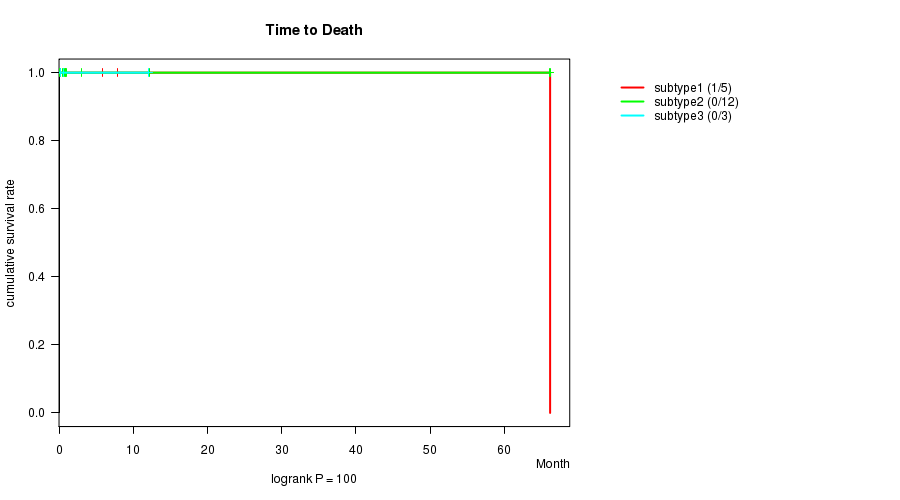
P value = 100 (logrank test), Q value = 1
Table S2. Clustering Approach #1: 'Copy Number Ratio CNMF subtypes' versus Clinical Feature #1: 'Time to Death'
| nPatients | nDeath | Duration Range (Median), Month | |
|---|---|---|---|
| ALL | 20 | 1 | 0.1 - 66.2 (0.9) |
| subtype1 | 5 | 1 | 0.1 - 66.2 (5.9) |
| subtype2 | 12 | 0 | 0.1 - 66.2 (0.8) |
| subtype3 | 3 | 0 | 0.2 - 12.0 (0.7) |
Figure S1. Get High-res Image Clustering Approach #1: 'Copy Number Ratio CNMF subtypes' versus Clinical Feature #1: 'Time to Death'
P value = 0.262 (ANOVA), Q value = 1
Table S3. Clustering Approach #1: 'Copy Number Ratio CNMF subtypes' versus Clinical Feature #2: 'AGE'
| nPatients | Mean (Std.Dev) | |
|---|---|---|
| ALL | 20 | 66.3 (9.1) |
| subtype1 | 5 | 69.4 (10.6) |
| subtype2 | 12 | 67.0 (8.5) |
| subtype3 | 3 | 58.7 (7.0) |
Figure S2. Get High-res Image Clustering Approach #1: 'Copy Number Ratio CNMF subtypes' versus Clinical Feature #2: 'AGE'

P value = 1 (Fisher's exact test), Q value = 1
Table S4. Clustering Approach #1: 'Copy Number Ratio CNMF subtypes' versus Clinical Feature #3: 'GENDER'
| nPatients | FEMALE | MALE |
|---|---|---|
| ALL | 10 | 10 |
| subtype1 | 2 | 3 |
| subtype2 | 6 | 6 |
| subtype3 | 2 | 1 |
Figure S3. Get High-res Image Clustering Approach #1: 'Copy Number Ratio CNMF subtypes' versus Clinical Feature #3: 'GENDER'

P value = 0.809 (Chi-square test), Q value = 1
Table S5. Clustering Approach #1: 'Copy Number Ratio CNMF subtypes' versus Clinical Feature #4: 'HISTOLOGICAL.TYPE'
| nPatients | PANCREAS-ADENOCARCINOMA DUCTAL TYPE | PANCREAS-ADENOCARCINOMA-OTHER SUBTYPE | PANCREAS-COLLOID (MUCINOUS NON-CYSTIC) CARCINOMA |
|---|---|---|---|
| ALL | 17 | 2 | 1 |
| subtype1 | 4 | 1 | 0 |
| subtype2 | 10 | 1 | 1 |
| subtype3 | 3 | 0 | 0 |
Figure S4. Get High-res Image Clustering Approach #1: 'Copy Number Ratio CNMF subtypes' versus Clinical Feature #4: 'HISTOLOGICAL.TYPE'

P value = 0.0182 (Chi-square test), Q value = 1
Table S6. Clustering Approach #1: 'Copy Number Ratio CNMF subtypes' versus Clinical Feature #5: 'DISTANT.METASTASIS'
| nPatients | M0 | M1 | MX |
|---|---|---|---|
| ALL | 3 | 1 | 16 |
| subtype1 | 2 | 0 | 3 |
| subtype2 | 0 | 0 | 12 |
| subtype3 | 1 | 1 | 1 |
Figure S5. Get High-res Image Clustering Approach #1: 'Copy Number Ratio CNMF subtypes' versus Clinical Feature #5: 'DISTANT.METASTASIS'

P value = 0.0637 (Fisher's exact test), Q value = 1
Table S7. Clustering Approach #1: 'Copy Number Ratio CNMF subtypes' versus Clinical Feature #6: 'LYMPH.NODE.METASTASIS'
| nPatients | N0 | N1 |
|---|---|---|
| ALL | 8 | 12 |
| subtype1 | 0 | 5 |
| subtype2 | 7 | 5 |
| subtype3 | 1 | 2 |
Figure S6. Get High-res Image Clustering Approach #1: 'Copy Number Ratio CNMF subtypes' versus Clinical Feature #6: 'LYMPH.NODE.METASTASIS'

P value = 0.411 (Chi-square test), Q value = 1
Table S8. Clustering Approach #1: 'Copy Number Ratio CNMF subtypes' versus Clinical Feature #7: 'COMPLETENESS.OF.RESECTION'
| nPatients | R0 | R1 | RX |
|---|---|---|---|
| ALL | 13 | 5 | 2 |
| subtype1 | 3 | 1 | 1 |
| subtype2 | 9 | 2 | 1 |
| subtype3 | 1 | 2 | 0 |
Figure S7. Get High-res Image Clustering Approach #1: 'Copy Number Ratio CNMF subtypes' versus Clinical Feature #7: 'COMPLETENESS.OF.RESECTION'

P value = 0.0219 (ANOVA), Q value = 1
Table S9. Clustering Approach #1: 'Copy Number Ratio CNMF subtypes' versus Clinical Feature #8: 'NUMBER.OF.LYMPH.NODES'
| nPatients | Mean (Std.Dev) | |
|---|---|---|
| ALL | 20 | 2.0 (2.9) |
| subtype1 | 5 | 5.0 (4.3) |
| subtype2 | 12 | 1.0 (1.5) |
| subtype3 | 3 | 1.3 (1.2) |
Figure S8. Get High-res Image Clustering Approach #1: 'Copy Number Ratio CNMF subtypes' versus Clinical Feature #8: 'NUMBER.OF.LYMPH.NODES'

P value = 0.262 (Chi-square test), Q value = 1
Table S10. Clustering Approach #1: 'Copy Number Ratio CNMF subtypes' versus Clinical Feature #10: 'NEOPLASM.DISEASESTAGE'
| nPatients | STAGE IA | STAGE IB | STAGE IIA | STAGE IIB | STAGE III | STAGE IV |
|---|---|---|---|---|---|---|
| ALL | 2 | 1 | 3 | 12 | 1 | 1 |
| subtype1 | 0 | 0 | 0 | 5 | 0 | 0 |
| subtype2 | 2 | 1 | 3 | 5 | 1 | 0 |
| subtype3 | 0 | 0 | 0 | 2 | 0 | 1 |
Figure S9. Get High-res Image Clustering Approach #1: 'Copy Number Ratio CNMF subtypes' versus Clinical Feature #10: 'NEOPLASM.DISEASESTAGE'

Table S11. Get Full Table Description of clustering approach #2: 'METHLYATION CNMF'
| Cluster Labels | 1 | 2 | 3 |
|---|---|---|---|
| Number of samples | 9 | 13 | 4 |
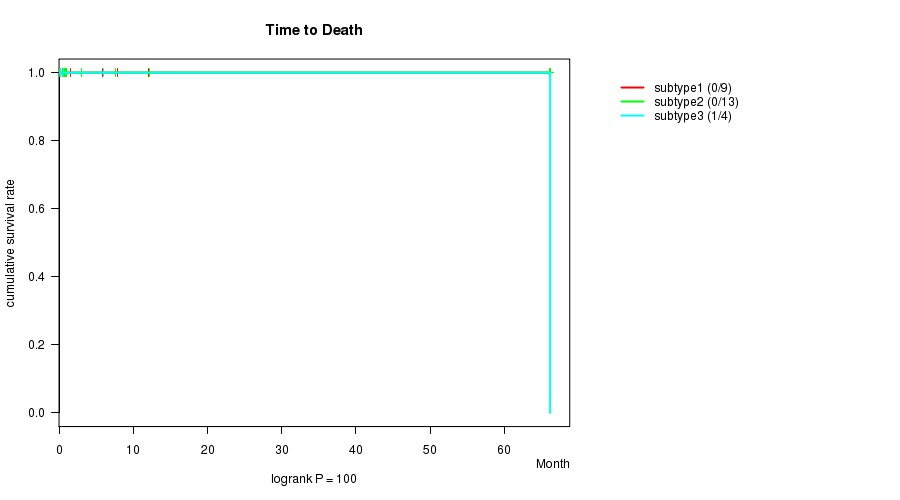
P value = 100 (logrank test), Q value = 1
Table S12. Clustering Approach #2: 'METHLYATION CNMF' versus Clinical Feature #1: 'Time to Death'
| nPatients | nDeath | Duration Range (Median), Month | |
|---|---|---|---|
| ALL | 26 | 1 | 0.1 - 66.2 (1.0) |
| subtype1 | 9 | 0 | 0.1 - 66.2 (1.5) |
| subtype2 | 13 | 0 | 0.1 - 66.2 (1.0) |
| subtype3 | 4 | 1 | 0.3 - 66.2 (3.3) |
Figure S10. Get High-res Image Clustering Approach #2: 'METHLYATION CNMF' versus Clinical Feature #1: 'Time to Death'
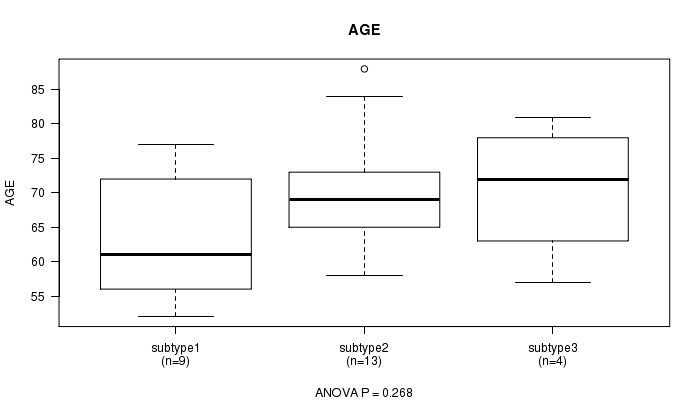
P value = 0.268 (ANOVA), Q value = 1
Table S13. Clustering Approach #2: 'METHLYATION CNMF' versus Clinical Feature #2: 'AGE'
| nPatients | Mean (Std.Dev) | |
|---|---|---|
| ALL | 26 | 67.9 (9.5) |
| subtype1 | 9 | 63.7 (9.7) |
| subtype2 | 13 | 70.0 (8.9) |
| subtype3 | 4 | 70.5 (10.2) |
Figure S11. Get High-res Image Clustering Approach #2: 'METHLYATION CNMF' versus Clinical Feature #2: 'AGE'
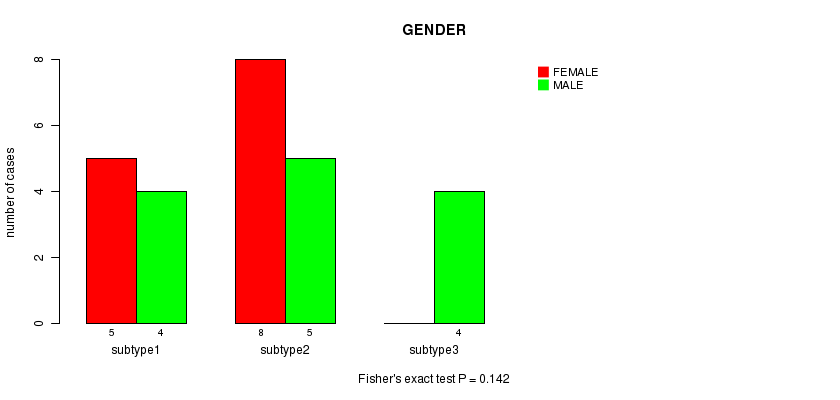
P value = 0.142 (Fisher's exact test), Q value = 1
Table S14. Clustering Approach #2: 'METHLYATION CNMF' versus Clinical Feature #3: 'GENDER'
| nPatients | FEMALE | MALE |
|---|---|---|
| ALL | 13 | 13 |
| subtype1 | 5 | 4 |
| subtype2 | 8 | 5 |
| subtype3 | 0 | 4 |
Figure S12. Get High-res Image Clustering Approach #2: 'METHLYATION CNMF' versus Clinical Feature #3: 'GENDER'
P value = 0.716 (Chi-square test), Q value = 1
Table S15. Clustering Approach #2: 'METHLYATION CNMF' versus Clinical Feature #4: 'HISTOLOGICAL.TYPE'
| nPatients | PANCREAS-ADENOCARCINOMA DUCTAL TYPE | PANCREAS-ADENOCARCINOMA-OTHER SUBTYPE | PANCREAS-COLLOID (MUCINOUS NON-CYSTIC) CARCINOMA |
|---|---|---|---|
| ALL | 21 | 4 | 1 |
| subtype1 | 7 | 2 | 0 |
| subtype2 | 10 | 2 | 1 |
| subtype3 | 4 | 0 | 0 |
Figure S13. Get High-res Image Clustering Approach #2: 'METHLYATION CNMF' versus Clinical Feature #4: 'HISTOLOGICAL.TYPE'

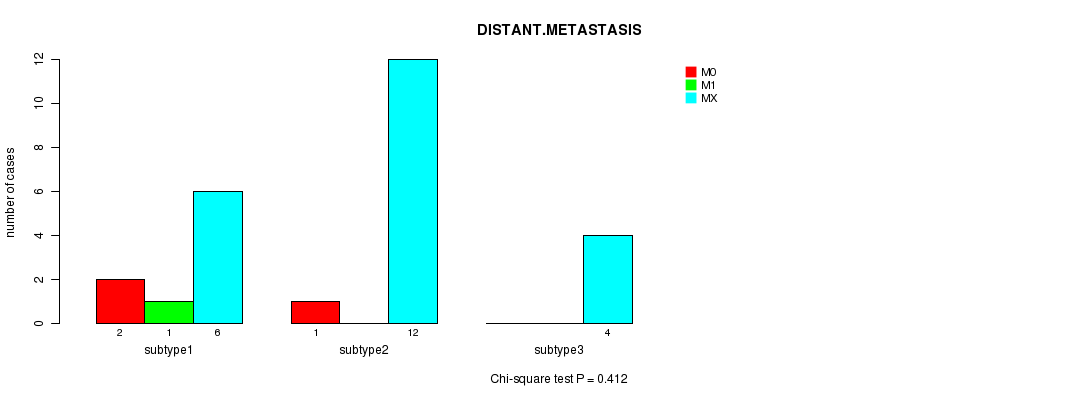
P value = 0.412 (Chi-square test), Q value = 1
Table S16. Clustering Approach #2: 'METHLYATION CNMF' versus Clinical Feature #5: 'DISTANT.METASTASIS'
| nPatients | M0 | M1 | MX |
|---|---|---|---|
| ALL | 3 | 1 | 22 |
| subtype1 | 2 | 1 | 6 |
| subtype2 | 1 | 0 | 12 |
| subtype3 | 0 | 0 | 4 |
Figure S14. Get High-res Image Clustering Approach #2: 'METHLYATION CNMF' versus Clinical Feature #5: 'DISTANT.METASTASIS'
P value = 0.172 (Chi-square test), Q value = 1
Table S17. Clustering Approach #2: 'METHLYATION CNMF' versus Clinical Feature #6: 'LYMPH.NODE.METASTASIS'
| nPatients | N0 | N1 | N1B |
|---|---|---|---|
| ALL | 8 | 17 | 1 |
| subtype1 | 2 | 7 | 0 |
| subtype2 | 5 | 8 | 0 |
| subtype3 | 1 | 2 | 1 |
Figure S15. Get High-res Image Clustering Approach #2: 'METHLYATION CNMF' versus Clinical Feature #6: 'LYMPH.NODE.METASTASIS'

P value = 0.0899 (Chi-square test), Q value = 1
Table S18. Clustering Approach #2: 'METHLYATION CNMF' versus Clinical Feature #7: 'COMPLETENESS.OF.RESECTION'
| nPatients | R0 | R1 | RX |
|---|---|---|---|
| ALL | 14 | 9 | 2 |
| subtype1 | 3 | 5 | 1 |
| subtype2 | 10 | 2 | 0 |
| subtype3 | 1 | 2 | 1 |
Figure S16. Get High-res Image Clustering Approach #2: 'METHLYATION CNMF' versus Clinical Feature #7: 'COMPLETENESS.OF.RESECTION'

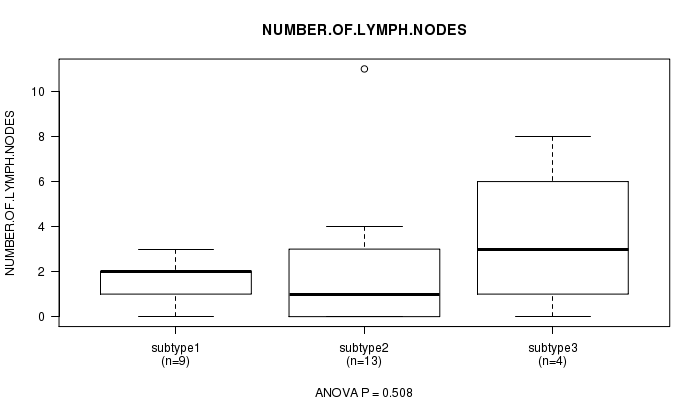
P value = 0.508 (ANOVA), Q value = 1
Table S19. Clustering Approach #2: 'METHLYATION CNMF' versus Clinical Feature #8: 'NUMBER.OF.LYMPH.NODES'
| nPatients | Mean (Std.Dev) | |
|---|---|---|
| ALL | 26 | 2.1 (2.6) |
| subtype1 | 9 | 1.7 (1.1) |
| subtype2 | 13 | 2.0 (3.1) |
| subtype3 | 4 | 3.5 (3.4) |
Figure S17. Get High-res Image Clustering Approach #2: 'METHLYATION CNMF' versus Clinical Feature #8: 'NUMBER.OF.LYMPH.NODES'
P value = 0.339 (Chi-square test), Q value = 1
Table S20. Clustering Approach #2: 'METHLYATION CNMF' versus Clinical Feature #10: 'NEOPLASM.DISEASESTAGE'
| nPatients | STAGE IA | STAGE IB | STAGE IIA | STAGE IIB | STAGE III | STAGE IV |
|---|---|---|---|---|---|---|
| ALL | 2 | 1 | 3 | 18 | 1 | 1 |
| subtype1 | 0 | 0 | 1 | 7 | 0 | 1 |
| subtype2 | 2 | 1 | 2 | 8 | 0 | 0 |
| subtype3 | 0 | 0 | 0 | 3 | 1 | 0 |
Figure S18. Get High-res Image Clustering Approach #2: 'METHLYATION CNMF' versus Clinical Feature #10: 'NEOPLASM.DISEASESTAGE'

Table S21. Get Full Table Description of clustering approach #3: 'RNAseq CNMF subtypes'
| Cluster Labels | 1 | 2 |
|---|---|---|
| Number of samples | 10 | 8 |
P value = 100 (logrank test), Q value = 1
Table S22. Clustering Approach #3: 'RNAseq CNMF subtypes' versus Clinical Feature #1: 'Time to Death'
| nPatients | nDeath | Duration Range (Median), Month | |
|---|---|---|---|
| ALL | 18 | 0 | 0.1 - 66.2 (0.8) |
| subtype1 | 10 | 0 | 0.1 - 12.1 (0.8) |
| subtype2 | 8 | 0 | 0.1 - 66.2 (0.8) |
Figure S19. Get High-res Image Clustering Approach #3: 'RNAseq CNMF subtypes' versus Clinical Feature #1: 'Time to Death'

P value = 0.0527 (t-test), Q value = 1
Table S23. Clustering Approach #3: 'RNAseq CNMF subtypes' versus Clinical Feature #2: 'AGE'
| nPatients | Mean (Std.Dev) | |
|---|---|---|
| ALL | 18 | 64.9 (8.4) |
| subtype1 | 10 | 61.7 (9.4) |
| subtype2 | 8 | 69.0 (5.0) |
Figure S20. Get High-res Image Clustering Approach #3: 'RNAseq CNMF subtypes' versus Clinical Feature #2: 'AGE'

P value = 0.0536 (Fisher's exact test), Q value = 1
Table S24. Clustering Approach #3: 'RNAseq CNMF subtypes' versus Clinical Feature #3: 'GENDER'
| nPatients | FEMALE | MALE |
|---|---|---|
| ALL | 10 | 8 |
| subtype1 | 8 | 2 |
| subtype2 | 2 | 6 |
Figure S21. Get High-res Image Clustering Approach #3: 'RNAseq CNMF subtypes' versus Clinical Feature #3: 'GENDER'

P value = 0.358 (Chi-square test), Q value = 1
Table S25. Clustering Approach #3: 'RNAseq CNMF subtypes' versus Clinical Feature #4: 'HISTOLOGICAL.TYPE'
| nPatients | PANCREAS-ADENOCARCINOMA DUCTAL TYPE | PANCREAS-ADENOCARCINOMA-OTHER SUBTYPE | PANCREAS-COLLOID (MUCINOUS NON-CYSTIC) CARCINOMA |
|---|---|---|---|
| ALL | 16 | 1 | 1 |
| subtype1 | 9 | 0 | 1 |
| subtype2 | 7 | 1 | 0 |
Figure S22. Get High-res Image Clustering Approach #3: 'RNAseq CNMF subtypes' versus Clinical Feature #4: 'HISTOLOGICAL.TYPE'

P value = 0.57 (Chi-square test), Q value = 1
Table S26. Clustering Approach #3: 'RNAseq CNMF subtypes' versus Clinical Feature #5: 'DISTANT.METASTASIS'
| nPatients | M0 | M1 | MX |
|---|---|---|---|
| ALL | 3 | 1 | 14 |
| subtype1 | 2 | 1 | 7 |
| subtype2 | 1 | 0 | 7 |
Figure S23. Get High-res Image Clustering Approach #3: 'RNAseq CNMF subtypes' versus Clinical Feature #5: 'DISTANT.METASTASIS'

P value = 1 (Fisher's exact test), Q value = 1
Table S27. Clustering Approach #3: 'RNAseq CNMF subtypes' versus Clinical Feature #6: 'LYMPH.NODE.METASTASIS'
| nPatients | N0 | N1 |
|---|---|---|
| ALL | 8 | 10 |
| subtype1 | 4 | 6 |
| subtype2 | 4 | 4 |
Figure S24. Get High-res Image Clustering Approach #3: 'RNAseq CNMF subtypes' versus Clinical Feature #6: 'LYMPH.NODE.METASTASIS'

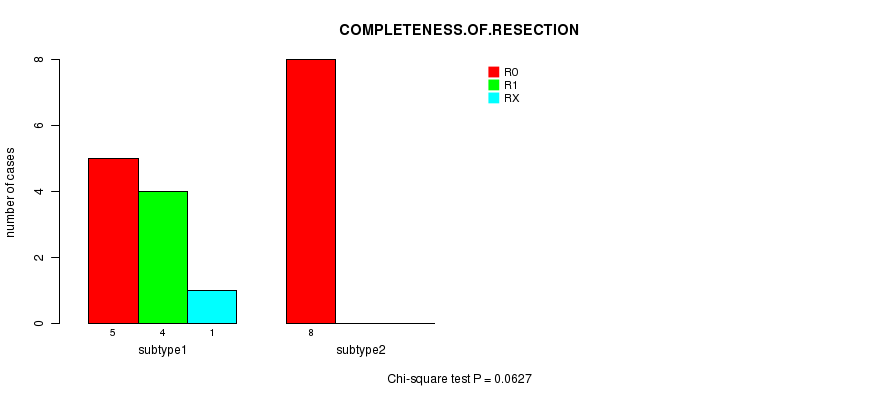
P value = 0.0627 (Chi-square test), Q value = 1
Table S28. Clustering Approach #3: 'RNAseq CNMF subtypes' versus Clinical Feature #7: 'COMPLETENESS.OF.RESECTION'
| nPatients | R0 | R1 | RX |
|---|---|---|---|
| ALL | 13 | 4 | 1 |
| subtype1 | 5 | 4 | 1 |
| subtype2 | 8 | 0 | 0 |
Figure S25. Get High-res Image Clustering Approach #3: 'RNAseq CNMF subtypes' versus Clinical Feature #7: 'COMPLETENESS.OF.RESECTION'
P value = 0.673 (t-test), Q value = 1
Table S29. Clustering Approach #3: 'RNAseq CNMF subtypes' versus Clinical Feature #8: 'NUMBER.OF.LYMPH.NODES'
| nPatients | Mean (Std.Dev) | |
|---|---|---|
| ALL | 18 | 1.8 (2.7) |
| subtype1 | 10 | 1.5 (1.4) |
| subtype2 | 8 | 2.1 (3.8) |
Figure S26. Get High-res Image Clustering Approach #3: 'RNAseq CNMF subtypes' versus Clinical Feature #8: 'NUMBER.OF.LYMPH.NODES'

P value = 0.615 (Chi-square test), Q value = 1
Table S30. Clustering Approach #3: 'RNAseq CNMF subtypes' versus Clinical Feature #10: 'NEOPLASM.DISEASESTAGE'
| nPatients | STAGE IA | STAGE IB | STAGE IIA | STAGE IIB | STAGE III | STAGE IV |
|---|---|---|---|---|---|---|
| ALL | 2 | 1 | 3 | 10 | 1 | 1 |
| subtype1 | 1 | 0 | 2 | 6 | 0 | 1 |
| subtype2 | 1 | 1 | 1 | 4 | 1 | 0 |
Figure S27. Get High-res Image Clustering Approach #3: 'RNAseq CNMF subtypes' versus Clinical Feature #10: 'NEOPLASM.DISEASESTAGE'

Table S31. Get Full Table Description of clustering approach #4: 'RNAseq cHierClus subtypes'
| Cluster Labels | 1 | 2 | 3 |
|---|---|---|---|
| Number of samples | 4 | 8 | 6 |
P value = 100 (logrank test), Q value = 1
Table S32. Clustering Approach #4: 'RNAseq cHierClus subtypes' versus Clinical Feature #1: 'Time to Death'
| nPatients | nDeath | Duration Range (Median), Month | |
|---|---|---|---|
| ALL | 18 | 0 | 0.1 - 66.2 (0.8) |
| subtype1 | 4 | 0 | 0.3 - 12.1 (1.7) |
| subtype2 | 8 | 0 | 0.1 - 66.2 (0.8) |
| subtype3 | 6 | 0 | 0.1 - 12.0 (0.8) |
Figure S28. Get High-res Image Clustering Approach #4: 'RNAseq cHierClus subtypes' versus Clinical Feature #1: 'Time to Death'

P value = 0.0268 (ANOVA), Q value = 1
Table S33. Clustering Approach #4: 'RNAseq cHierClus subtypes' versus Clinical Feature #2: 'AGE'
| nPatients | Mean (Std.Dev) | |
|---|---|---|
| ALL | 18 | 64.9 (8.4) |
| subtype1 | 4 | 67.5 (12.1) |
| subtype2 | 8 | 69.0 (5.0) |
| subtype3 | 6 | 57.8 (5.1) |
Figure S29. Get High-res Image Clustering Approach #4: 'RNAseq cHierClus subtypes' versus Clinical Feature #2: 'AGE'

P value = 0.101 (Fisher's exact test), Q value = 1
Table S34. Clustering Approach #4: 'RNAseq cHierClus subtypes' versus Clinical Feature #3: 'GENDER'
| nPatients | FEMALE | MALE |
|---|---|---|
| ALL | 10 | 8 |
| subtype1 | 3 | 1 |
| subtype2 | 2 | 6 |
| subtype3 | 5 | 1 |
Figure S30. Get High-res Image Clustering Approach #4: 'RNAseq cHierClus subtypes' versus Clinical Feature #3: 'GENDER'

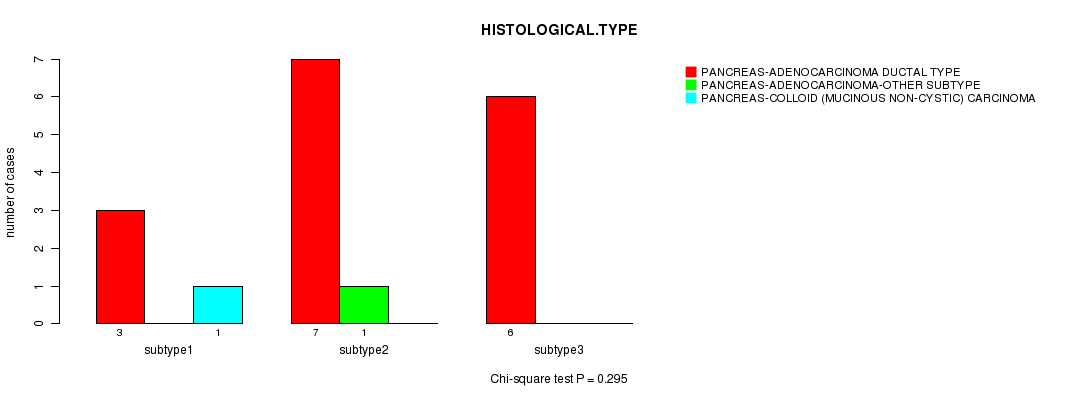
P value = 0.295 (Chi-square test), Q value = 1
Table S35. Clustering Approach #4: 'RNAseq cHierClus subtypes' versus Clinical Feature #4: 'HISTOLOGICAL.TYPE'
| nPatients | PANCREAS-ADENOCARCINOMA DUCTAL TYPE | PANCREAS-ADENOCARCINOMA-OTHER SUBTYPE | PANCREAS-COLLOID (MUCINOUS NON-CYSTIC) CARCINOMA |
|---|---|---|---|
| ALL | 16 | 1 | 1 |
| subtype1 | 3 | 0 | 1 |
| subtype2 | 7 | 1 | 0 |
| subtype3 | 6 | 0 | 0 |
Figure S31. Get High-res Image Clustering Approach #4: 'RNAseq cHierClus subtypes' versus Clinical Feature #4: 'HISTOLOGICAL.TYPE'
P value = 0.32 (Chi-square test), Q value = 1
Table S36. Clustering Approach #4: 'RNAseq cHierClus subtypes' versus Clinical Feature #5: 'DISTANT.METASTASIS'
| nPatients | M0 | M1 | MX |
|---|---|---|---|
| ALL | 3 | 1 | 14 |
| subtype1 | 0 | 0 | 4 |
| subtype2 | 1 | 0 | 7 |
| subtype3 | 2 | 1 | 3 |
Figure S32. Get High-res Image Clustering Approach #4: 'RNAseq cHierClus subtypes' versus Clinical Feature #5: 'DISTANT.METASTASIS'

P value = 0.846 (Fisher's exact test), Q value = 1
Table S37. Clustering Approach #4: 'RNAseq cHierClus subtypes' versus Clinical Feature #6: 'LYMPH.NODE.METASTASIS'
| nPatients | N0 | N1 |
|---|---|---|
| ALL | 8 | 10 |
| subtype1 | 2 | 2 |
| subtype2 | 4 | 4 |
| subtype3 | 2 | 4 |
Figure S33. Get High-res Image Clustering Approach #4: 'RNAseq cHierClus subtypes' versus Clinical Feature #6: 'LYMPH.NODE.METASTASIS'

P value = 0.0633 (Chi-square test), Q value = 1
Table S38. Clustering Approach #4: 'RNAseq cHierClus subtypes' versus Clinical Feature #7: 'COMPLETENESS.OF.RESECTION'
| nPatients | R0 | R1 | RX |
|---|---|---|---|
| ALL | 13 | 4 | 1 |
| subtype1 | 2 | 1 | 1 |
| subtype2 | 8 | 0 | 0 |
| subtype3 | 3 | 3 | 0 |
Figure S34. Get High-res Image Clustering Approach #4: 'RNAseq cHierClus subtypes' versus Clinical Feature #7: 'COMPLETENESS.OF.RESECTION'

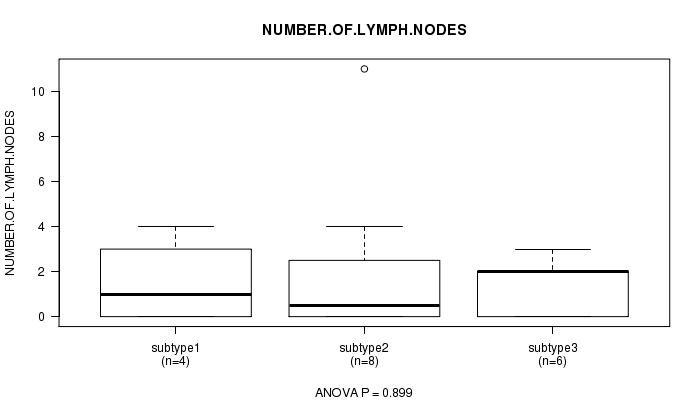
P value = 0.899 (ANOVA), Q value = 1
Table S39. Clustering Approach #4: 'RNAseq cHierClus subtypes' versus Clinical Feature #8: 'NUMBER.OF.LYMPH.NODES'
| nPatients | Mean (Std.Dev) | |
|---|---|---|
| ALL | 18 | 1.8 (2.7) |
| subtype1 | 4 | 1.5 (1.9) |
| subtype2 | 8 | 2.1 (3.8) |
| subtype3 | 6 | 1.5 (1.2) |
Figure S35. Get High-res Image Clustering Approach #4: 'RNAseq cHierClus subtypes' versus Clinical Feature #8: 'NUMBER.OF.LYMPH.NODES'
P value = 0.787 (Chi-square test), Q value = 1
Table S40. Clustering Approach #4: 'RNAseq cHierClus subtypes' versus Clinical Feature #10: 'NEOPLASM.DISEASESTAGE'
| nPatients | STAGE IA | STAGE IB | STAGE IIA | STAGE IIB | STAGE III | STAGE IV |
|---|---|---|---|---|---|---|
| ALL | 2 | 1 | 3 | 10 | 1 | 1 |
| subtype1 | 1 | 0 | 1 | 2 | 0 | 0 |
| subtype2 | 1 | 1 | 1 | 4 | 1 | 0 |
| subtype3 | 0 | 0 | 1 | 4 | 0 | 1 |
Figure S36. Get High-res Image Clustering Approach #4: 'RNAseq cHierClus subtypes' versus Clinical Feature #10: 'NEOPLASM.DISEASESTAGE'
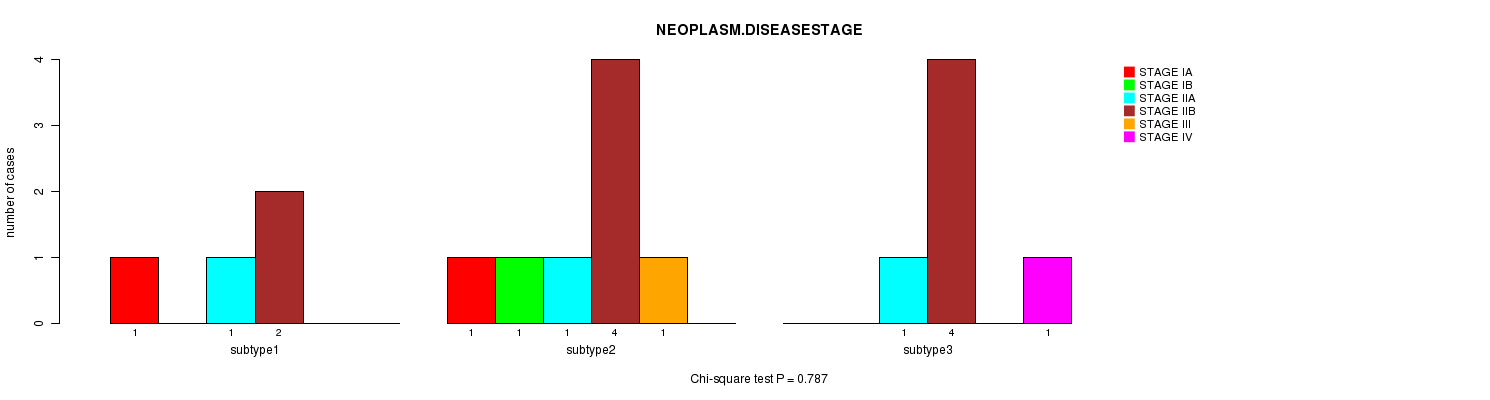
Table S41. Get Full Table Description of clustering approach #5: 'MIRSEQ CNMF'
| Cluster Labels | 1 | 2 | 3 | 4 | 5 |
|---|---|---|---|---|---|
| Number of samples | 5 | 3 | 5 | 3 | 4 |
P value = 100 (logrank test), Q value = 1
Table S42. Clustering Approach #5: 'MIRSEQ CNMF' versus Clinical Feature #1: 'Time to Death'
| nPatients | nDeath | Duration Range (Median), Month | |
|---|---|---|---|
| ALL | 20 | 1 | 0.1 - 66.2 (0.9) |
| subtype1 | 5 | 0 | 0.1 - 5.9 (0.7) |
| subtype2 | 3 | 0 | 0.7 - 1.0 (0.9) |
| subtype3 | 5 | 0 | 0.1 - 66.2 (0.6) |
| subtype4 | 3 | 0 | 3.0 - 12.1 (7.9) |
| subtype5 | 4 | 1 | 0.3 - 66.2 (6.3) |
Figure S37. Get High-res Image Clustering Approach #5: 'MIRSEQ CNMF' versus Clinical Feature #1: 'Time to Death'

P value = 0.0251 (ANOVA), Q value = 1
Table S43. Clustering Approach #5: 'MIRSEQ CNMF' versus Clinical Feature #2: 'AGE'
| nPatients | Mean (Std.Dev) | |
|---|---|---|
| ALL | 20 | 66.3 (9.1) |
| subtype1 | 5 | 56.2 (3.5) |
| subtype2 | 3 | 66.0 (5.6) |
| subtype3 | 5 | 70.8 (4.1) |
| subtype4 | 3 | 73.7 (12.3) |
| subtype5 | 4 | 68.2 (9.9) |
Figure S38. Get High-res Image Clustering Approach #5: 'MIRSEQ CNMF' versus Clinical Feature #2: 'AGE'

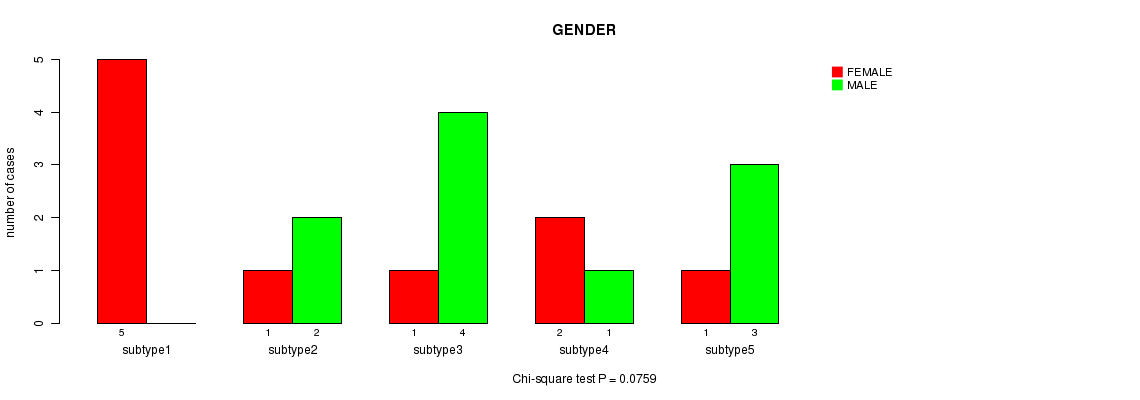
P value = 0.0759 (Chi-square test), Q value = 1
Table S44. Clustering Approach #5: 'MIRSEQ CNMF' versus Clinical Feature #3: 'GENDER'
| nPatients | FEMALE | MALE |
|---|---|---|
| ALL | 10 | 10 |
| subtype1 | 5 | 0 |
| subtype2 | 1 | 2 |
| subtype3 | 1 | 4 |
| subtype4 | 2 | 1 |
| subtype5 | 1 | 3 |
Figure S39. Get High-res Image Clustering Approach #5: 'MIRSEQ CNMF' versus Clinical Feature #3: 'GENDER'
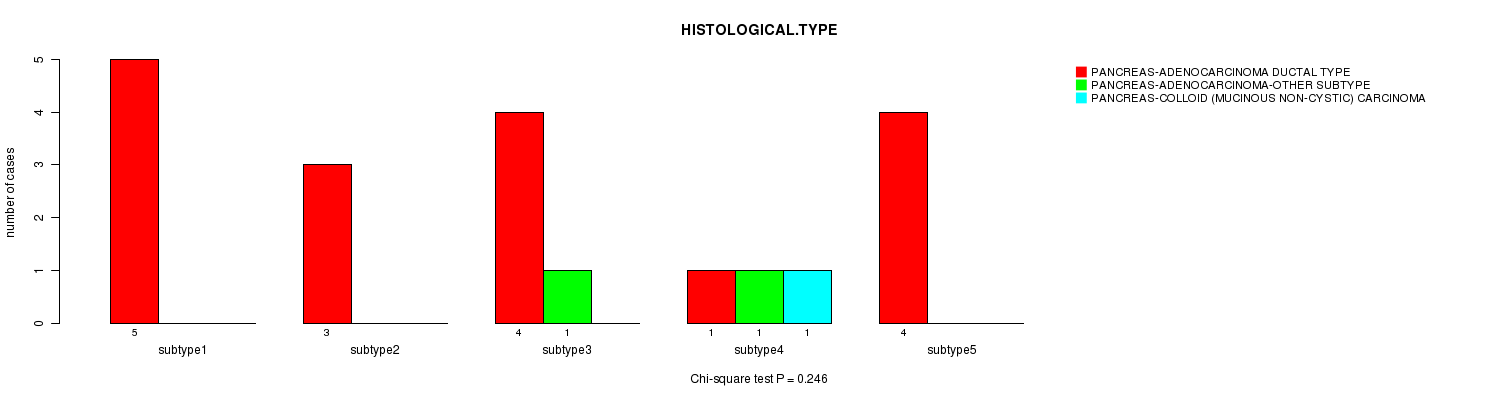
P value = 0.246 (Chi-square test), Q value = 1
Table S45. Clustering Approach #5: 'MIRSEQ CNMF' versus Clinical Feature #4: 'HISTOLOGICAL.TYPE'
| nPatients | PANCREAS-ADENOCARCINOMA DUCTAL TYPE | PANCREAS-ADENOCARCINOMA-OTHER SUBTYPE | PANCREAS-COLLOID (MUCINOUS NON-CYSTIC) CARCINOMA |
|---|---|---|---|
| ALL | 17 | 2 | 1 |
| subtype1 | 5 | 0 | 0 |
| subtype2 | 3 | 0 | 0 |
| subtype3 | 4 | 1 | 0 |
| subtype4 | 1 | 1 | 1 |
| subtype5 | 4 | 0 | 0 |
Figure S40. Get High-res Image Clustering Approach #5: 'MIRSEQ CNMF' versus Clinical Feature #4: 'HISTOLOGICAL.TYPE'
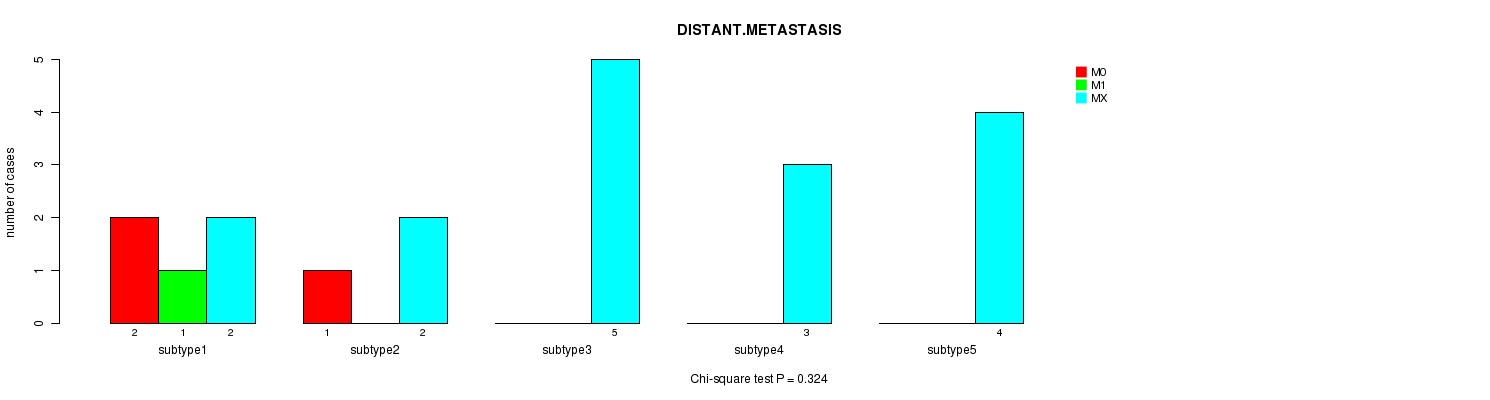
P value = 0.324 (Chi-square test), Q value = 1
Table S46. Clustering Approach #5: 'MIRSEQ CNMF' versus Clinical Feature #5: 'DISTANT.METASTASIS'
| nPatients | M0 | M1 | MX |
|---|---|---|---|
| ALL | 3 | 1 | 16 |
| subtype1 | 2 | 1 | 2 |
| subtype2 | 1 | 0 | 2 |
| subtype3 | 0 | 0 | 5 |
| subtype4 | 0 | 0 | 3 |
| subtype5 | 0 | 0 | 4 |
Figure S41. Get High-res Image Clustering Approach #5: 'MIRSEQ CNMF' versus Clinical Feature #5: 'DISTANT.METASTASIS'
P value = 0.0639 (Chi-square test), Q value = 1
Table S47. Clustering Approach #5: 'MIRSEQ CNMF' versus Clinical Feature #6: 'LYMPH.NODE.METASTASIS'
| nPatients | N0 | N1 |
|---|---|---|
| ALL | 8 | 12 |
| subtype1 | 2 | 3 |
| subtype2 | 0 | 3 |
| subtype3 | 4 | 1 |
| subtype4 | 2 | 1 |
| subtype5 | 0 | 4 |
Figure S42. Get High-res Image Clustering Approach #5: 'MIRSEQ CNMF' versus Clinical Feature #6: 'LYMPH.NODE.METASTASIS'

P value = 0.112 (Chi-square test), Q value = 1
Table S48. Clustering Approach #5: 'MIRSEQ CNMF' versus Clinical Feature #7: 'COMPLETENESS.OF.RESECTION'
| nPatients | R0 | R1 | RX |
|---|---|---|---|
| ALL | 13 | 5 | 2 |
| subtype1 | 2 | 3 | 0 |
| subtype2 | 3 | 0 | 0 |
| subtype3 | 5 | 0 | 0 |
| subtype4 | 2 | 0 | 1 |
| subtype5 | 1 | 2 | 1 |
Figure S43. Get High-res Image Clustering Approach #5: 'MIRSEQ CNMF' versus Clinical Feature #7: 'COMPLETENESS.OF.RESECTION'

P value = 0.0388 (ANOVA), Q value = 1
Table S49. Clustering Approach #5: 'MIRSEQ CNMF' versus Clinical Feature #8: 'NUMBER.OF.LYMPH.NODES'
| nPatients | Mean (Std.Dev) | |
|---|---|---|
| ALL | 20 | 2.0 (2.9) |
| subtype1 | 5 | 1.4 (1.3) |
| subtype2 | 3 | 5.3 (5.1) |
| subtype3 | 5 | 0.2 (0.4) |
| subtype4 | 3 | 0.3 (0.6) |
| subtype5 | 4 | 4.0 (2.8) |
Figure S44. Get High-res Image Clustering Approach #5: 'MIRSEQ CNMF' versus Clinical Feature #8: 'NUMBER.OF.LYMPH.NODES'

P value = 0.602 (Chi-square test), Q value = 1
Table S50. Clustering Approach #5: 'MIRSEQ CNMF' versus Clinical Feature #10: 'NEOPLASM.DISEASESTAGE'
| nPatients | STAGE IA | STAGE IB | STAGE IIA | STAGE IIB | STAGE III | STAGE IV |
|---|---|---|---|---|---|---|
| ALL | 2 | 1 | 3 | 12 | 1 | 1 |
| subtype1 | 0 | 0 | 1 | 3 | 0 | 1 |
| subtype2 | 0 | 0 | 0 | 3 | 0 | 0 |
| subtype3 | 1 | 1 | 1 | 1 | 1 | 0 |
| subtype4 | 1 | 0 | 1 | 1 | 0 | 0 |
| subtype5 | 0 | 0 | 0 | 4 | 0 | 0 |
Figure S45. Get High-res Image Clustering Approach #5: 'MIRSEQ CNMF' versus Clinical Feature #10: 'NEOPLASM.DISEASESTAGE'

Table S51. Get Full Table Description of clustering approach #6: 'MIRSEQ CHIERARCHICAL'
| Cluster Labels | 1 | 2 | 3 |
|---|---|---|---|
| Number of samples | 8 | 5 | 7 |
P value = 100 (logrank test), Q value = 1
Table S52. Clustering Approach #6: 'MIRSEQ CHIERARCHICAL' versus Clinical Feature #1: 'Time to Death'
| nPatients | nDeath | Duration Range (Median), Month | |
|---|---|---|---|
| ALL | 20 | 1 | 0.1 - 66.2 (0.9) |
| subtype1 | 8 | 1 | 0.2 - 66.2 (6.9) |
| subtype2 | 5 | 0 | 0.1 - 66.2 (0.6) |
| subtype3 | 7 | 0 | 0.1 - 1.0 (0.7) |
Figure S46. Get High-res Image Clustering Approach #6: 'MIRSEQ CHIERARCHICAL' versus Clinical Feature #1: 'Time to Death'

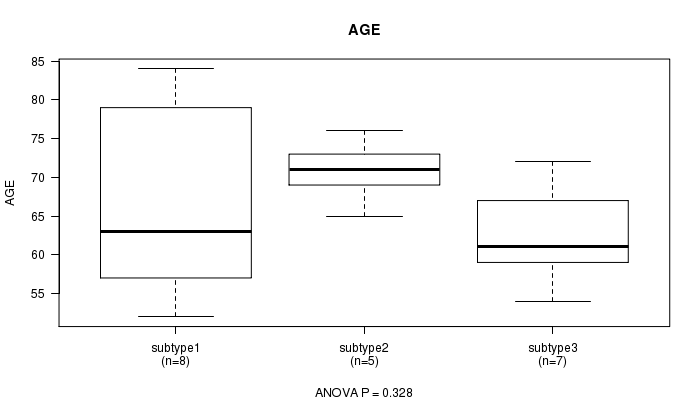
P value = 0.328 (ANOVA), Q value = 1
Table S53. Clustering Approach #6: 'MIRSEQ CHIERARCHICAL' versus Clinical Feature #2: 'AGE'
| nPatients | Mean (Std.Dev) | |
|---|---|---|
| ALL | 20 | 66.3 (9.1) |
| subtype1 | 8 | 66.8 (12.3) |
| subtype2 | 5 | 70.8 (4.1) |
| subtype3 | 7 | 62.7 (6.4) |
Figure S47. Get High-res Image Clustering Approach #6: 'MIRSEQ CHIERARCHICAL' versus Clinical Feature #2: 'AGE'
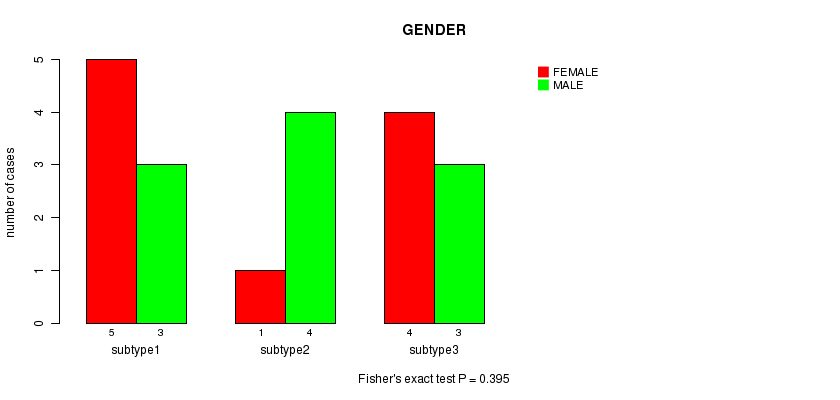
P value = 0.395 (Fisher's exact test), Q value = 1
Table S54. Clustering Approach #6: 'MIRSEQ CHIERARCHICAL' versus Clinical Feature #3: 'GENDER'
| nPatients | FEMALE | MALE |
|---|---|---|
| ALL | 10 | 10 |
| subtype1 | 5 | 3 |
| subtype2 | 1 | 4 |
| subtype3 | 4 | 3 |
Figure S48. Get High-res Image Clustering Approach #6: 'MIRSEQ CHIERARCHICAL' versus Clinical Feature #3: 'GENDER'
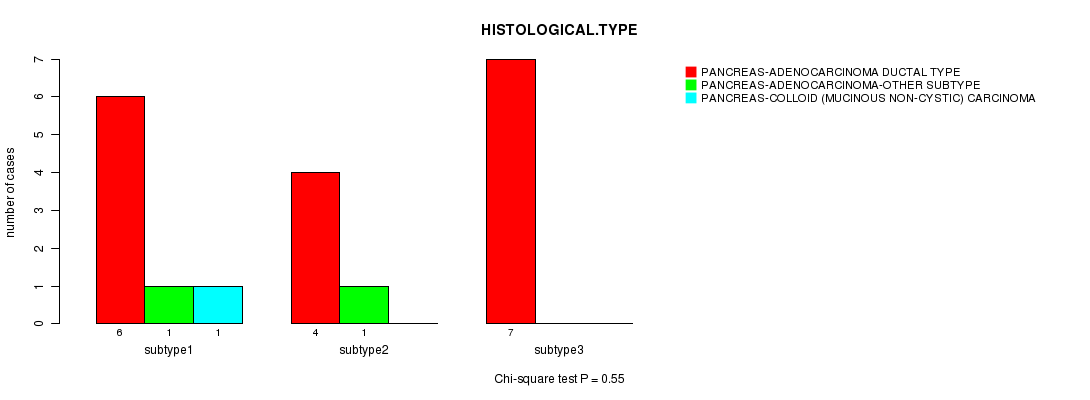
P value = 0.55 (Chi-square test), Q value = 1
Table S55. Clustering Approach #6: 'MIRSEQ CHIERARCHICAL' versus Clinical Feature #4: 'HISTOLOGICAL.TYPE'
| nPatients | PANCREAS-ADENOCARCINOMA DUCTAL TYPE | PANCREAS-ADENOCARCINOMA-OTHER SUBTYPE | PANCREAS-COLLOID (MUCINOUS NON-CYSTIC) CARCINOMA |
|---|---|---|---|
| ALL | 17 | 2 | 1 |
| subtype1 | 6 | 1 | 1 |
| subtype2 | 4 | 1 | 0 |
| subtype3 | 7 | 0 | 0 |
Figure S49. Get High-res Image Clustering Approach #6: 'MIRSEQ CHIERARCHICAL' versus Clinical Feature #4: 'HISTOLOGICAL.TYPE'
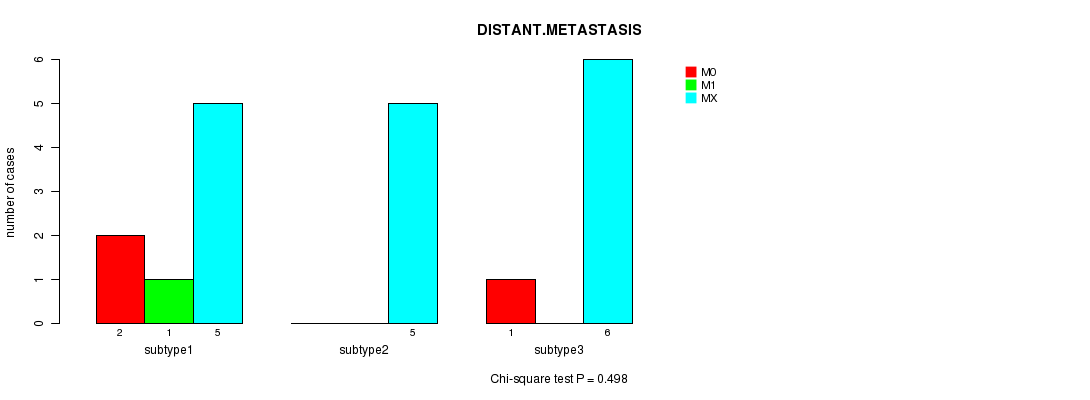
P value = 0.498 (Chi-square test), Q value = 1
Table S56. Clustering Approach #6: 'MIRSEQ CHIERARCHICAL' versus Clinical Feature #5: 'DISTANT.METASTASIS'
| nPatients | M0 | M1 | MX |
|---|---|---|---|
| ALL | 3 | 1 | 16 |
| subtype1 | 2 | 1 | 5 |
| subtype2 | 0 | 0 | 5 |
| subtype3 | 1 | 0 | 6 |
Figure S50. Get High-res Image Clustering Approach #6: 'MIRSEQ CHIERARCHICAL' versus Clinical Feature #5: 'DISTANT.METASTASIS'
P value = 0.0987 (Fisher's exact test), Q value = 1
Table S57. Clustering Approach #6: 'MIRSEQ CHIERARCHICAL' versus Clinical Feature #6: 'LYMPH.NODE.METASTASIS'
| nPatients | N0 | N1 |
|---|---|---|
| ALL | 8 | 12 |
| subtype1 | 3 | 5 |
| subtype2 | 4 | 1 |
| subtype3 | 1 | 6 |
Figure S51. Get High-res Image Clustering Approach #6: 'MIRSEQ CHIERARCHICAL' versus Clinical Feature #6: 'LYMPH.NODE.METASTASIS'

P value = 0.441 (Chi-square test), Q value = 1
Table S58. Clustering Approach #6: 'MIRSEQ CHIERARCHICAL' versus Clinical Feature #7: 'COMPLETENESS.OF.RESECTION'
| nPatients | R0 | R1 | RX |
|---|---|---|---|
| ALL | 13 | 5 | 2 |
| subtype1 | 4 | 3 | 1 |
| subtype2 | 5 | 0 | 0 |
| subtype3 | 4 | 2 | 1 |
Figure S52. Get High-res Image Clustering Approach #6: 'MIRSEQ CHIERARCHICAL' versus Clinical Feature #7: 'COMPLETENESS.OF.RESECTION'

P value = 0.137 (ANOVA), Q value = 1
Table S59. Clustering Approach #6: 'MIRSEQ CHIERARCHICAL' versus Clinical Feature #8: 'NUMBER.OF.LYMPH.NODES'
| nPatients | Mean (Std.Dev) | |
|---|---|---|
| ALL | 20 | 2.0 (2.9) |
| subtype1 | 8 | 1.9 (2.6) |
| subtype2 | 5 | 0.2 (0.4) |
| subtype3 | 7 | 3.6 (3.6) |
Figure S53. Get High-res Image Clustering Approach #6: 'MIRSEQ CHIERARCHICAL' versus Clinical Feature #8: 'NUMBER.OF.LYMPH.NODES'

P value = 0.359 (Chi-square test), Q value = 1
Table S60. Clustering Approach #6: 'MIRSEQ CHIERARCHICAL' versus Clinical Feature #10: 'NEOPLASM.DISEASESTAGE'
| nPatients | STAGE IA | STAGE IB | STAGE IIA | STAGE IIB | STAGE III | STAGE IV |
|---|---|---|---|---|---|---|
| ALL | 2 | 1 | 3 | 12 | 1 | 1 |
| subtype1 | 1 | 0 | 1 | 5 | 0 | 1 |
| subtype2 | 1 | 1 | 1 | 1 | 1 | 0 |
| subtype3 | 0 | 0 | 1 | 6 | 0 | 0 |
Figure S54. Get High-res Image Clustering Approach #6: 'MIRSEQ CHIERARCHICAL' versus Clinical Feature #10: 'NEOPLASM.DISEASESTAGE'
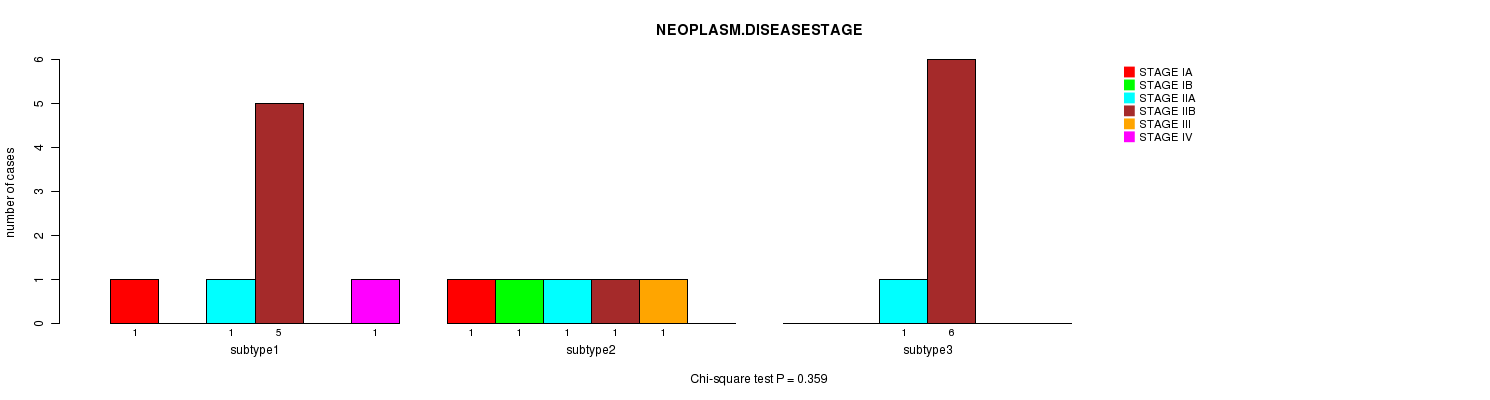
Table S61. Get Full Table Description of clustering approach #7: 'MIRseq Mature CNMF subtypes'
| Cluster Labels | 1 | 2 |
|---|---|---|
| Number of samples | 11 | 9 |
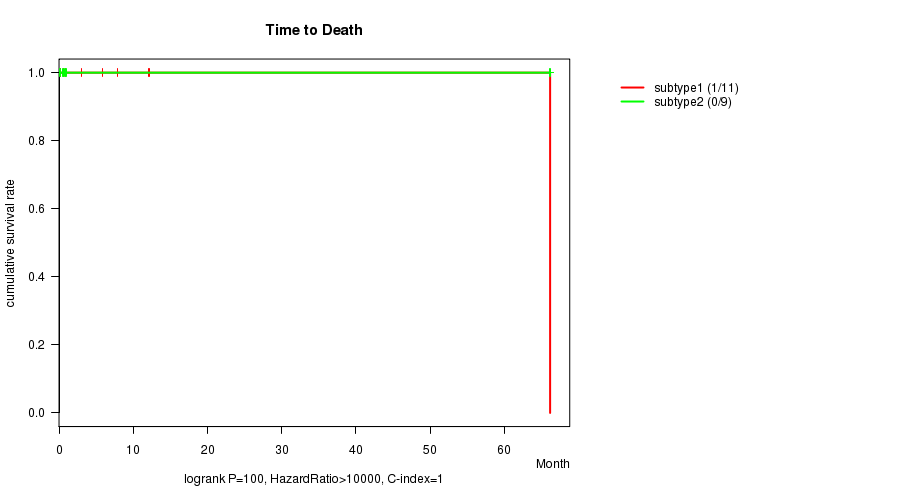
P value = 100 (logrank test), Q value = 1
Table S62. Clustering Approach #7: 'MIRseq Mature CNMF subtypes' versus Clinical Feature #1: 'Time to Death'
| nPatients | nDeath | Duration Range (Median), Month | |
|---|---|---|---|
| ALL | 20 | 1 | 0.1 - 66.2 (0.9) |
| subtype1 | 11 | 1 | 0.1 - 66.2 (3.0) |
| subtype2 | 9 | 0 | 0.1 - 66.2 (0.7) |
Figure S55. Get High-res Image Clustering Approach #7: 'MIRseq Mature CNMF subtypes' versus Clinical Feature #1: 'Time to Death'
P value = 0.22 (t-test), Q value = 1
Table S63. Clustering Approach #7: 'MIRseq Mature CNMF subtypes' versus Clinical Feature #2: 'AGE'
| nPatients | Mean (Std.Dev) | |
|---|---|---|
| ALL | 20 | 66.3 (9.1) |
| subtype1 | 11 | 64.2 (11.3) |
| subtype2 | 9 | 69.0 (4.7) |
Figure S56. Get High-res Image Clustering Approach #7: 'MIRseq Mature CNMF subtypes' versus Clinical Feature #2: 'AGE'

P value = 0.37 (Fisher's exact test), Q value = 1
Table S64. Clustering Approach #7: 'MIRseq Mature CNMF subtypes' versus Clinical Feature #3: 'GENDER'
| nPatients | FEMALE | MALE |
|---|---|---|
| ALL | 10 | 10 |
| subtype1 | 7 | 4 |
| subtype2 | 3 | 6 |
Figure S57. Get High-res Image Clustering Approach #7: 'MIRseq Mature CNMF subtypes' versus Clinical Feature #3: 'GENDER'

P value = 0.648 (Chi-square test), Q value = 1
Table S65. Clustering Approach #7: 'MIRseq Mature CNMF subtypes' versus Clinical Feature #4: 'HISTOLOGICAL.TYPE'
| nPatients | PANCREAS-ADENOCARCINOMA DUCTAL TYPE | PANCREAS-ADENOCARCINOMA-OTHER SUBTYPE | PANCREAS-COLLOID (MUCINOUS NON-CYSTIC) CARCINOMA |
|---|---|---|---|
| ALL | 17 | 2 | 1 |
| subtype1 | 9 | 1 | 1 |
| subtype2 | 8 | 1 | 0 |
Figure S58. Get High-res Image Clustering Approach #7: 'MIRseq Mature CNMF subtypes' versus Clinical Feature #4: 'HISTOLOGICAL.TYPE'

P value = 0.564 (Chi-square test), Q value = 1
Table S66. Clustering Approach #7: 'MIRseq Mature CNMF subtypes' versus Clinical Feature #5: 'DISTANT.METASTASIS'
| nPatients | M0 | M1 | MX |
|---|---|---|---|
| ALL | 3 | 1 | 16 |
| subtype1 | 2 | 1 | 8 |
| subtype2 | 1 | 0 | 8 |
Figure S59. Get High-res Image Clustering Approach #7: 'MIRseq Mature CNMF subtypes' versus Clinical Feature #5: 'DISTANT.METASTASIS'

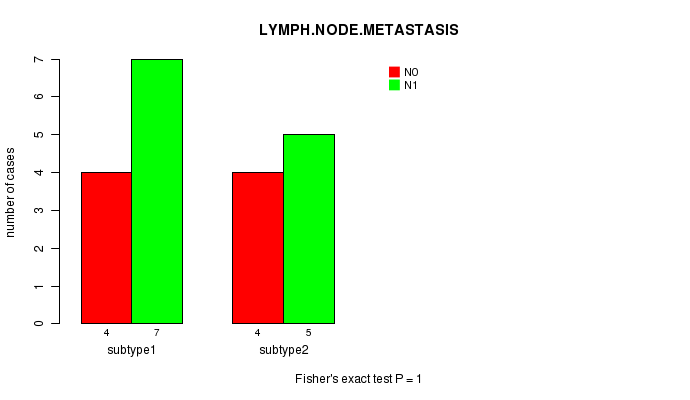
P value = 1 (Fisher's exact test), Q value = 1
Table S67. Clustering Approach #7: 'MIRseq Mature CNMF subtypes' versus Clinical Feature #6: 'LYMPH.NODE.METASTASIS'
| nPatients | N0 | N1 |
|---|---|---|
| ALL | 8 | 12 |
| subtype1 | 4 | 7 |
| subtype2 | 4 | 5 |
Figure S60. Get High-res Image Clustering Approach #7: 'MIRseq Mature CNMF subtypes' versus Clinical Feature #6: 'LYMPH.NODE.METASTASIS'
P value = 0.114 (Chi-square test), Q value = 1
Table S68. Clustering Approach #7: 'MIRseq Mature CNMF subtypes' versus Clinical Feature #7: 'COMPLETENESS.OF.RESECTION'
| nPatients | R0 | R1 | RX |
|---|---|---|---|
| ALL | 13 | 5 | 2 |
| subtype1 | 5 | 4 | 2 |
| subtype2 | 8 | 1 | 0 |
Figure S61. Get High-res Image Clustering Approach #7: 'MIRseq Mature CNMF subtypes' versus Clinical Feature #7: 'COMPLETENESS.OF.RESECTION'

P value = 0.719 (t-test), Q value = 1
Table S69. Clustering Approach #7: 'MIRseq Mature CNMF subtypes' versus Clinical Feature #8: 'NUMBER.OF.LYMPH.NODES'
| nPatients | Mean (Std.Dev) | |
|---|---|---|
| ALL | 20 | 2.0 (2.9) |
| subtype1 | 11 | 1.8 (2.3) |
| subtype2 | 9 | 2.3 (3.6) |
Figure S62. Get High-res Image Clustering Approach #7: 'MIRseq Mature CNMF subtypes' versus Clinical Feature #8: 'NUMBER.OF.LYMPH.NODES'

P value = 0.623 (Chi-square test), Q value = 1
Table S70. Clustering Approach #7: 'MIRseq Mature CNMF subtypes' versus Clinical Feature #10: 'NEOPLASM.DISEASESTAGE'
| nPatients | STAGE IA | STAGE IB | STAGE IIA | STAGE IIB | STAGE III | STAGE IV |
|---|---|---|---|---|---|---|
| ALL | 2 | 1 | 3 | 12 | 1 | 1 |
| subtype1 | 1 | 0 | 2 | 7 | 0 | 1 |
| subtype2 | 1 | 1 | 1 | 5 | 1 | 0 |
Figure S63. Get High-res Image Clustering Approach #7: 'MIRseq Mature CNMF subtypes' versus Clinical Feature #10: 'NEOPLASM.DISEASESTAGE'

Table S71. Get Full Table Description of clustering approach #8: 'MIRseq Mature cHierClus subtypes'
| Cluster Labels | 1 | 2 | 3 |
|---|---|---|---|
| Number of samples | 9 | 5 | 6 |
P value = 100 (logrank test), Q value = 1
Table S72. Clustering Approach #8: 'MIRseq Mature cHierClus subtypes' versus Clinical Feature #1: 'Time to Death'
| nPatients | nDeath | Duration Range (Median), Month | |
|---|---|---|---|
| ALL | 20 | 1 | 0.1 - 66.2 (0.9) |
| subtype1 | 9 | 1 | 0.2 - 66.2 (5.9) |
| subtype2 | 5 | 0 | 0.1 - 66.2 (0.6) |
| subtype3 | 6 | 0 | 0.1 - 1.0 (0.6) |
Figure S64. Get High-res Image Clustering Approach #8: 'MIRseq Mature cHierClus subtypes' versus Clinical Feature #1: 'Time to Death'

P value = 0.46 (ANOVA), Q value = 1
Table S73. Clustering Approach #8: 'MIRseq Mature cHierClus subtypes' versus Clinical Feature #2: 'AGE'
| nPatients | Mean (Std.Dev) | |
|---|---|---|
| ALL | 20 | 66.3 (9.1) |
| subtype1 | 9 | 65.3 (12.3) |
| subtype2 | 5 | 70.8 (4.1) |
| subtype3 | 6 | 64.2 (5.6) |
Figure S65. Get High-res Image Clustering Approach #8: 'MIRseq Mature cHierClus subtypes' versus Clinical Feature #2: 'AGE'

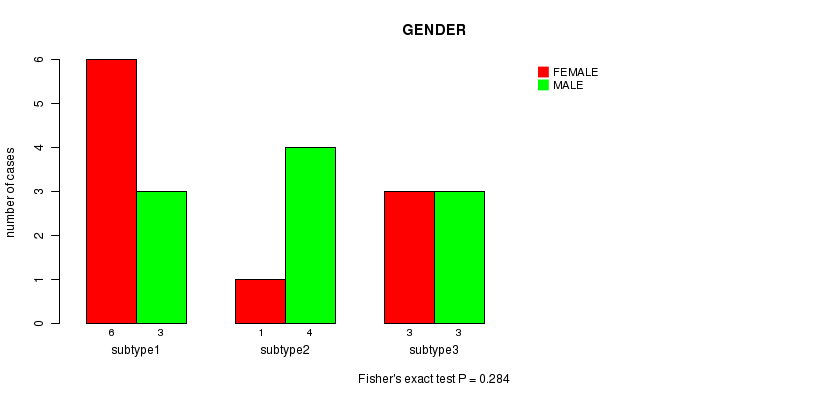
P value = 0.284 (Fisher's exact test), Q value = 1
Table S74. Clustering Approach #8: 'MIRseq Mature cHierClus subtypes' versus Clinical Feature #3: 'GENDER'
| nPatients | FEMALE | MALE |
|---|---|---|
| ALL | 10 | 10 |
| subtype1 | 6 | 3 |
| subtype2 | 1 | 4 |
| subtype3 | 3 | 3 |
Figure S66. Get High-res Image Clustering Approach #8: 'MIRseq Mature cHierClus subtypes' versus Clinical Feature #3: 'GENDER'
P value = 0.634 (Chi-square test), Q value = 1
Table S75. Clustering Approach #8: 'MIRseq Mature cHierClus subtypes' versus Clinical Feature #4: 'HISTOLOGICAL.TYPE'
| nPatients | PANCREAS-ADENOCARCINOMA DUCTAL TYPE | PANCREAS-ADENOCARCINOMA-OTHER SUBTYPE | PANCREAS-COLLOID (MUCINOUS NON-CYSTIC) CARCINOMA |
|---|---|---|---|
| ALL | 17 | 2 | 1 |
| subtype1 | 7 | 1 | 1 |
| subtype2 | 4 | 1 | 0 |
| subtype3 | 6 | 0 | 0 |
Figure S67. Get High-res Image Clustering Approach #8: 'MIRseq Mature cHierClus subtypes' versus Clinical Feature #4: 'HISTOLOGICAL.TYPE'

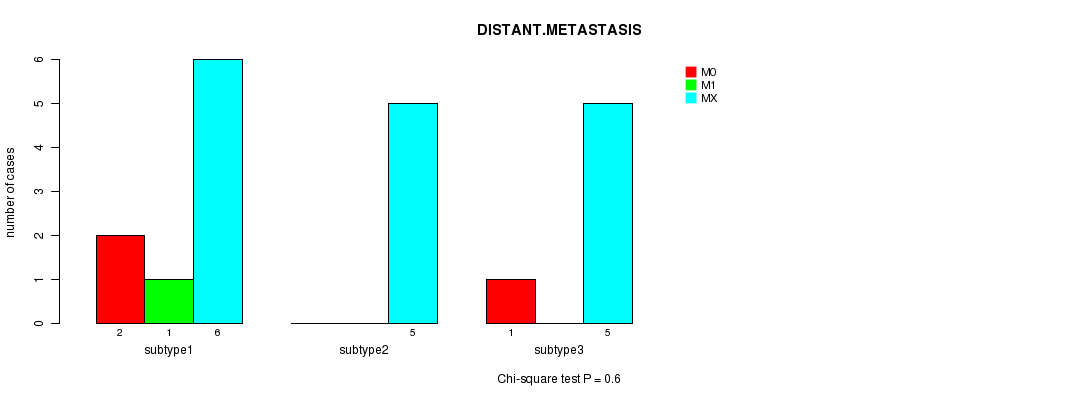
P value = 0.6 (Chi-square test), Q value = 1
Table S76. Clustering Approach #8: 'MIRseq Mature cHierClus subtypes' versus Clinical Feature #5: 'DISTANT.METASTASIS'
| nPatients | M0 | M1 | MX |
|---|---|---|---|
| ALL | 3 | 1 | 16 |
| subtype1 | 2 | 1 | 6 |
| subtype2 | 0 | 0 | 5 |
| subtype3 | 1 | 0 | 5 |
Figure S68. Get High-res Image Clustering Approach #8: 'MIRseq Mature cHierClus subtypes' versus Clinical Feature #5: 'DISTANT.METASTASIS'
P value = 0.0219 (Fisher's exact test), Q value = 1
Table S77. Clustering Approach #8: 'MIRseq Mature cHierClus subtypes' versus Clinical Feature #6: 'LYMPH.NODE.METASTASIS'
| nPatients | N0 | N1 |
|---|---|---|
| ALL | 8 | 12 |
| subtype1 | 4 | 5 |
| subtype2 | 4 | 1 |
| subtype3 | 0 | 6 |
Figure S69. Get High-res Image Clustering Approach #8: 'MIRseq Mature cHierClus subtypes' versus Clinical Feature #6: 'LYMPH.NODE.METASTASIS'

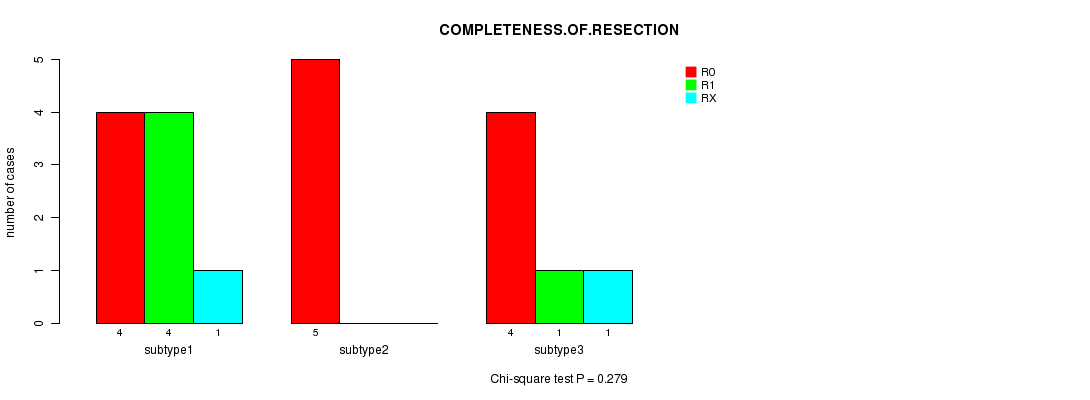
P value = 0.279 (Chi-square test), Q value = 1
Table S78. Clustering Approach #8: 'MIRseq Mature cHierClus subtypes' versus Clinical Feature #7: 'COMPLETENESS.OF.RESECTION'
| nPatients | R0 | R1 | RX |
|---|---|---|---|
| ALL | 13 | 5 | 2 |
| subtype1 | 4 | 4 | 1 |
| subtype2 | 5 | 0 | 0 |
| subtype3 | 4 | 1 | 1 |
Figure S70. Get High-res Image Clustering Approach #8: 'MIRseq Mature cHierClus subtypes' versus Clinical Feature #7: 'COMPLETENESS.OF.RESECTION'
P value = 0.0602 (ANOVA), Q value = 1
Table S79. Clustering Approach #8: 'MIRseq Mature cHierClus subtypes' versus Clinical Feature #8: 'NUMBER.OF.LYMPH.NODES'
| nPatients | Mean (Std.Dev) | |
|---|---|---|
| ALL | 20 | 2.0 (2.9) |
| subtype1 | 9 | 1.7 (2.5) |
| subtype2 | 5 | 0.2 (0.4) |
| subtype3 | 6 | 4.2 (3.5) |
Figure S71. Get High-res Image Clustering Approach #8: 'MIRseq Mature cHierClus subtypes' versus Clinical Feature #8: 'NUMBER.OF.LYMPH.NODES'

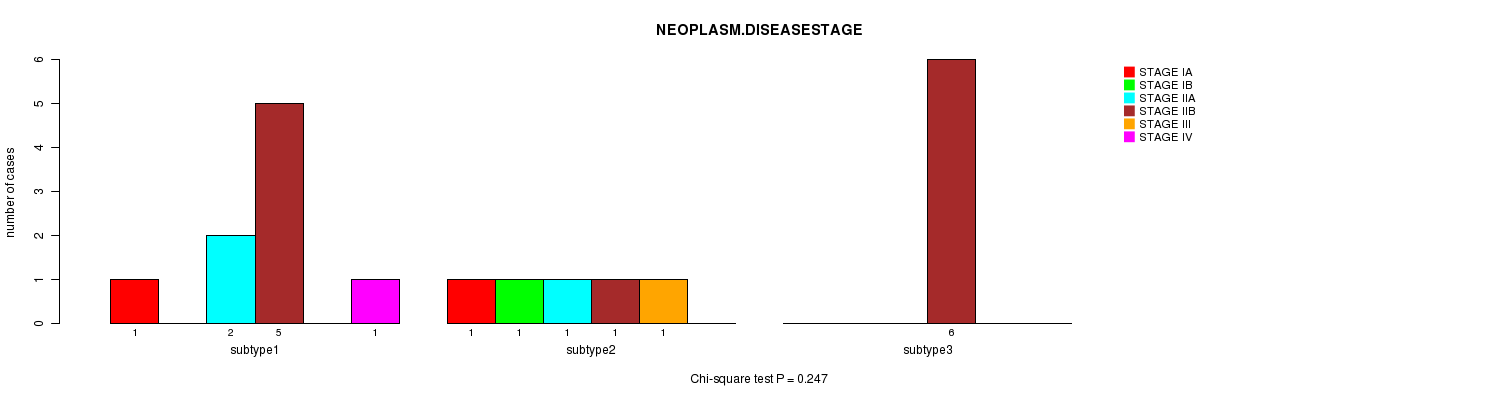
P value = 0.247 (Chi-square test), Q value = 1
Table S80. Clustering Approach #8: 'MIRseq Mature cHierClus subtypes' versus Clinical Feature #10: 'NEOPLASM.DISEASESTAGE'
| nPatients | STAGE IA | STAGE IB | STAGE IIA | STAGE IIB | STAGE III | STAGE IV |
|---|---|---|---|---|---|---|
| ALL | 2 | 1 | 3 | 12 | 1 | 1 |
| subtype1 | 1 | 0 | 2 | 5 | 0 | 1 |
| subtype2 | 1 | 1 | 1 | 1 | 1 | 0 |
| subtype3 | 0 | 0 | 0 | 6 | 0 | 0 |
Figure S72. Get High-res Image Clustering Approach #8: 'MIRseq Mature cHierClus subtypes' versus Clinical Feature #10: 'NEOPLASM.DISEASESTAGE'
-
Cluster data file = PAAD-TP.mergedcluster.txt
-
Clinical data file = PAAD-TP.clin.merged.picked.txt
-
Number of patients = 26
-
Number of clustering approaches = 8
-
Number of selected clinical features = 10
-
Exclude small clusters that include fewer than K patients, K = 3
consensus non-negative matrix factorization clustering approach (Brunet et al. 2004)
Resampling-based clustering method (Monti et al. 2003)
For survival clinical features, the Kaplan-Meier survival curves of tumors with and without gene mutations were plotted and the statistical significance P values were estimated by logrank test (Bland and Altman 2004) using the 'survdiff' function in R
For continuous numerical clinical features, one-way analysis of variance (Howell 2002) was applied to compare the clinical values between tumor subtypes using 'anova' function in R
For binary clinical features, two-tailed Fisher's exact tests (Fisher 1922) were used to estimate the P values using the 'fisher.test' function in R
For multi-class clinical features (nominal or ordinal), Chi-square tests (Greenwood and Nikulin 1996) were used to estimate the P values using the 'chisq.test' function in R
For continuous numerical clinical features, two-tailed Student's t test with unequal variance (Lehmann and Romano 2005) was applied to compare the clinical values between two tumor subtypes using 't.test' function in R
For multiple hypothesis correction, Q value is the False Discovery Rate (FDR) analogue of the P value (Benjamini and Hochberg 1995), defined as the minimum FDR at which the test may be called significant. We used the 'Benjamini and Hochberg' method of 'p.adjust' function in R to convert P values into Q values.
This is an experimental feature. The full results of the analysis summarized in this report can be downloaded from the TCGA Data Coordination Center.